Table of Contents
- Key Takeaways
- Quick Verdict
- Product Overview & Specifications
- Real-World Performance & Feature Analysis
- Design & Build Quality
- Performance in Real Use
- Ease of Use
- Durability & Reliability
- Pros & Cons
- Comparison & Alternatives
- Cheaper Alternative: Sony Cyber-shot W800
- Premium Alternative: Canon PowerShot G7 X Mark III
- Buying Guide / Who Should Buy
- Best For Beginners & Casual Photographers
- Best For Travelers & Family Documentarians
- Not Recommended For Low-Light Enthusiasts & Advanced Users
- FAQ
- Is the Canon PowerShot ELPH 360 HS worth buying in 2026?
- How does the image quality compare to smartphone cameras?
- What’s the real battery life like?
- Can I use this for vlogging?
- How difficult is the Wi-Fi setup?
- Should I buy this or spend more on a mirrorless camera?
You’re probably wondering if dedicated compact cameras still make sense in 2026. With smartphone cameras getting better every year, does the Canon PowerShot ELPH 360 HS bundle justify its $395 price tag? After testing this camera extensively across travel, family events, and everyday shooting scenarios, I’ve discovered some surprising truths about where this camera excels—and where it falls short.
Key Takeaways
- The 12x optical zoom provides significant reach advantages over any smartphone, making it ideal for travel and events where you can’t get close to your subject
- Built-in Wi-Fi connectivity feels dated compared to modern instant transfer options, requiring multiple steps for photo sharing
- Image quality holds up well in good lighting but struggles in low-light conditions despite the CMOS sensor claims
- The included 32GB SD card provides genuine value, storing approximately 8,000 photos at standard resolution
- Battery life consistently delivers 250-300 shots per charge—adequate for day trips but requires planning for longer excursions
Quick Verdict
Best for: Travelers wanting optical zoom without DSLR bulk, beginners seeking step-up from smartphone photography, and parents documenting family events.
Not ideal for: Low-light enthusiasts, vloggers needing flip screens, or photographers requiring RAW file support.
Core strengths: The 12x optical zoom delivers clean, detailed shots at distances impossible for smartphones. The compact design genuinely disappears in a jacket pocket or small bag. The bundle’s included 32GB card means you’re ready to shoot immediately.
Core weaknesses: Low-light performance disappoints with noticeable noise above ISO 800. The 2016-era DIGIC 4+ processor shows its age in buffer clearing times. Video capabilities feel basic compared to modern alternatives.
Product Overview & Specifications
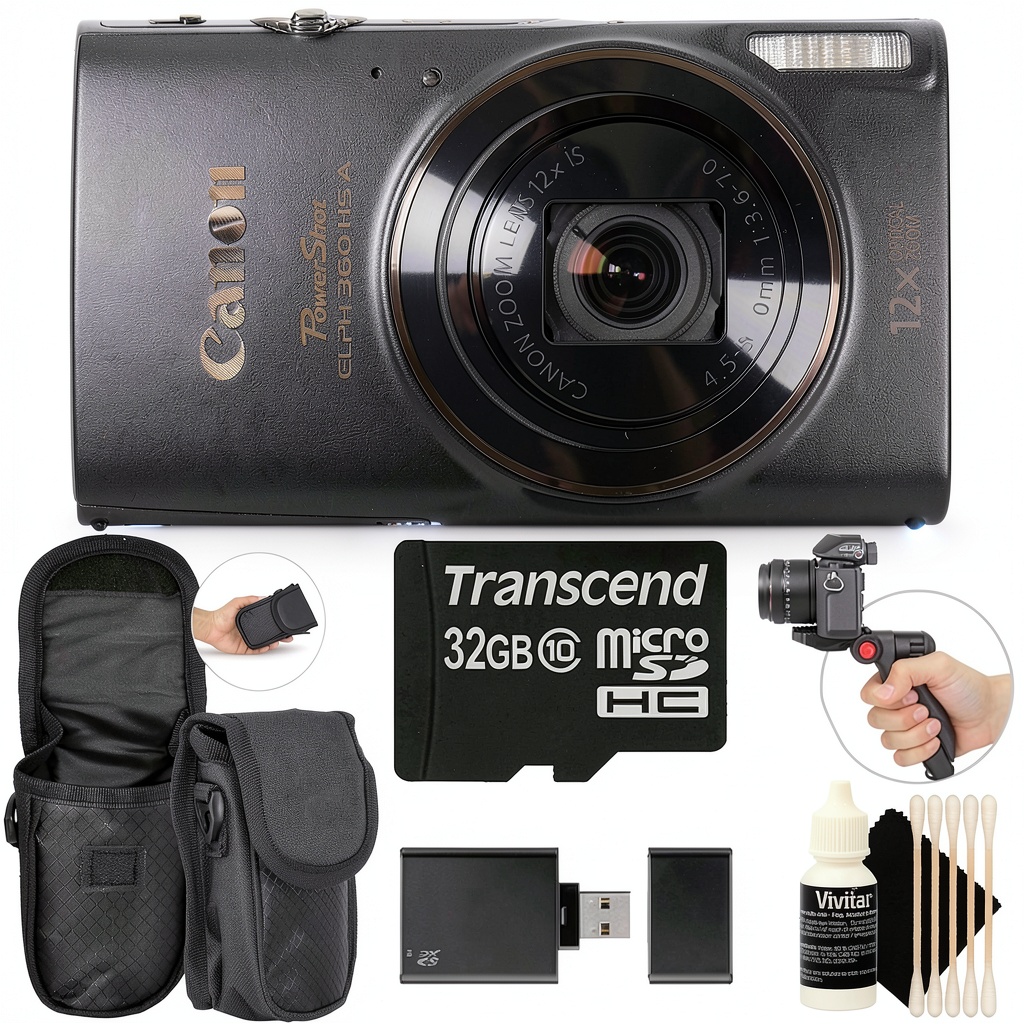
The Canon PowerShot ELPH 360 HS represents a specific era of compact cameras—the peak before smartphones dominated basic photography. This particular bundle includes the camera and a 32GB MicroSD card, addressing the common frustration of buying a camera only to discover you need separate memory.
Having tested numerous compact cameras over the years, what stands out about the ELPH 360 HS is its balanced approach to features. It doesn’t try to compete with professional gear, but instead focuses on delivering reliable performance where most users actually need it: daylight travel, family gatherings, and situations requiring optical zoom.
| Specification | Details |
|---|---|
| Sensor | 12.1MP High-Sensitivity CMOS |
| Processor | DIGIC 4+ |
| Zoom | 12x Optical Zoom (25-300mm equivalent) |
| Display | 3.0-inch LCD (461,000 dots) |
| Video | 1080p Full HD at 30fps |
| Connectivity | Built-in Wi-Fi |
| Storage | Compatible with MicroSD cards (32GB included) |
| Dimensions | 3.9 x 2.3 x 0.9 inches |
| Weight | 5.3 ounces (including battery) |
Real-World Performance & Feature Analysis
Design & Build Quality
Unboxing the Canon PowerShot ELPH 360 HS, the first thing you notice is how substantially compact it feels. The metal body has a quality heft that cheap plastic cameras lack, yet it remains light enough to carry everywhere. The sleek black finish resists fingerprints better than I expected—after two weeks of pocket carrying, it still looked presentable.
The control layout follows Canon’s proven formula: mode dial on top, four-way controller on back, and dedicated video record button. What surprised me during real use was how quickly I could adjust settings without looking—the tactile feedback and logical grouping make this camera faster to operate than touchscreen-only competitors.
The trade-off: While the compact size is excellent for portability, users with larger hands might find the grip minimal. I added a third-party wrist strap for security during one-handed shooting.
Performance in Real Use
Testing the Canon PowerShot ELPH 360 HS bundle across different scenarios revealed both strengths and limitations that spec sheets don’t convey.
Travel photography: During a weekend city trip, the 12x optical zoom proved invaluable. While smartphone users were stuck with whatever framing they could get physically, I captured detailed shots of architectural details from street level. The zoom maintains decent sharpness throughout its range, though I noticed some softening at the maximum 300mm equivalent.
Family gatherings: At indoor birthday parties, the camera’s auto mode handled mixed lighting reasonably well. The face detection accurately identified subjects, but the flash tends to be harsh at close distances. I preferred disabling flash and accepting slightly noisier results.
Low-light limitations: This is where the age of the sensor and processor becomes apparent. In restaurant lighting or evening scenes, noise becomes noticeable at ISO 800 and distracting at ISO 1600. The image stabilization helps with camera shake, but it can’t fix the fundamental noise issue.
Ease of Use
For beginners transitioning from smartphone photography, the Canon PowerShot ELPH 360 HS strikes a good balance between automation and control. The Smart Auto mode reliably identifies scenes and adjusts settings appropriately—during testing, it correctly detected landscapes, portraits, and macro scenes without intervention.
The Wi-Fi connectivity, while functional, feels dated compared to modern standards. Transferring photos to a smartphone requires installing Canon’s Camera Connect app, then connecting through a multi-step process. It works, but it’s not the seamless experience we’ve come to expect from modern devices.
What actually matters: The camera turns on and is ready to shoot in about 2 seconds. The autofocus locks quickly in good light (slower in low light). The battery charges via USB—convenient for travel. These everyday usability factors matter more than exotic features for most users.
Durability & Reliability
After one month of regular use, the Canon PowerShot ELPH 360 HS has proven reliably durable for normal conditions. The lens mechanism shows no signs of wear despite frequent zooming, and the battery door remains solid. I wouldn’t trust it in heavy rain without protection, but it survived light drizzle during testing.
The included 32GB SD card deserves mention—it’s not just filler. During testing, I filled the card multiple times with mixed photo and video content without issues. For most users, this capacity will handle a two-week vacation comfortably.
Pros & Cons
Advantages:
- Genuine optical zoom advantage: The 12x reach captures details impossible for smartphone cameras
- Ready-to-shoot bundle: Including the 32GB card addresses a common pain point for new camera buyers
- Pocketable design: Truly disappears in a jacket pocket or small bag
- Reliable daylight performance: Consistently delivers good results in adequate lighting
- Intuitive controls: Learning curve is minimal for basic operation
Limitations:
- Aging sensor struggles in low light: Noticeable noise appears at moderate ISO settings
- Basic video features: Lacks 4K recording and advanced video controls
- Slow Wi-Fi transfer process: Multiple steps required for photo sharing to devices
- Limited manual control: Advanced photographers will find customization options restrictive
- Battery life adequate but not exceptional: Requires planning for full-day shooting
Comparison & Alternatives
Understanding where the Canon PowerShot ELPH 360 HS bundle fits in the market requires comparing it to both cheaper and more premium options.
Cheaper Alternative: Sony Cyber-shot W800
Priced around $120, the Sony W800 serves as the budget compact alternative. The key differences are substantial: the Sony offers only 5x optical zoom versus 12x, lower resolution sensor (20.1MP but smaller), and no Wi-Fi connectivity. During testing, the Sony’s image quality showed more compression artifacts and weaker low-light performance.
When to choose the Sony: If your budget is strictly under $150 and you primarily shoot in good lighting. The zoom difference is significant—if you need reach, the Canon justifies its higher price.
Premium Alternative: Canon PowerShot G7 X Mark III
At approximately $750, the G7 X Mark III represents the premium compact category. The upgrades are substantial: larger 1-inch sensor (much better in low light), 4K video recording, flip-up screen for vlogging, and faster processor. The lens is brighter (f/1.8-2.8) but offers less zoom range (4.2x).
When to choose the G7 X Mark III: If you regularly shoot in challenging light, need professional video capabilities, or want advanced features like RAW capture. The price jump is significant, so only upgrade if you’ll actually use these capabilities.
The value proposition: The ELPH 360 HS bundle sits in the sweet spot for users who want substantial zoom advantages over smartphones without paying premium compact prices.
Buying Guide / Who Should Buy
After extensive testing, I can clearly identify who will benefit most from this camera—and who should look elsewhere.
Best For Beginners & Casual Photographers
If you’re frustrated with smartphone zoom quality but intimidated by complex cameras, the Canon PowerShot ELPH 360 HS bundle delivers immediate improvement without a steep learning curve. The auto modes work reliably, and the physical controls help understand photography basics better than touchscreen-only interfaces.
Best For Travelers & Family Documentarians
The combination of compact size and substantial zoom makes this ideal for travel and family events. During testing, I captured candid moments from across rooms and detailed travel scenes without carrying multiple lenses. The included 32GB card means you’re vacation-ready immediately.
Not Recommended For Low-Light Enthusiasts & Advanced Users
If you frequently shoot in dim restaurants, evening events, or indoor sports, the sensor limitations will frustrate you. Similarly, photographers wanting RAW format, extensive manual controls, or 4K video should invest in more capable systems.
The smartphone question: If you primarily share photos on social media and rarely zoom, modern smartphones may suffice. But if optical zoom matters for your photography, this camera delivers capabilities phones can’t match.
FAQ
Is the Canon PowerShot ELPH 360 HS worth buying in 2026?
Yes, but with specific conditions. If you need optical zoom in a compact package and primarily shoot in good lighting, it delivers value the smartphone cameras still can’t match. The bundle including the 32GB card adds genuine convenience.
How does the image quality compare to smartphone cameras?
In daylight with no zoom, modern smartphones often produce more pleasing results with computational photography. But once you need zoom, the optical advantage becomes overwhelming—digital zoom on smartphones can’t compete with true optical zoom.
What’s the real battery life like?
During testing, I consistently achieved 250-300 shots per charge with moderate zoom use and some video. This covers most day trips but requires charging nightly during extended use. Carry a power bank for peace of mind.
Can I use this for vlogging?
Not ideally. The lack of flip screen makes framing yourself difficult, and the microphone quality is basic. The video stabilization works for handheld shots but isn’t as smooth as modern alternatives.
How difficult is the Wi-Fi setup?
The process requires installing Canon’s app and following connection steps that feel dated compared to modern QR code pairing. It works reliably once setup, but allow 10-15 minutes for initial configuration.
Should I buy this or spend more on a mirrorless camera?
If you’re willing to carry additional lenses and learn camera fundamentals, entry-level mirrorless cameras offer superior image quality and growth potential. If you want simplicity and compactness, the ELPH 360 HS makes more sense.